On Resilience
A Sojourn into Grief, Part 8 & Epilogue

One of my soul friends asked me the other week, “How were you so resilient through this?”
Was I? I kind of feel like a mess!
By what measure did she think I was so resilient? Was she merely perceiving an outward resilience based on my demeanor, rather than that deeper “actual” internal resilience that I might not have been feeling? (I’m not sure if our outward actions provide accurate clues about whether we’re being resilient versus avoidant…)
But let’s say that I was internally resilient, it made me wonder: what would be my alternative? What would “less” resilience look like? Would I be crying “too much,” or having “lower” function, or grief that lasted “too long?” Compared to what? Imagine “perfect” resilience: does that mean I wouldn’t be sad at all? That doesn’t seem right.
A lot has been written about how grief will just move at its own pace, and that it’s highly unique to each individual (if you’re a crier you might cry a lot, and if you’re not you might not, and neither of those is “wrong”). I’m not sure if there is really any way for a person to do it “better” or “worse” — they’re going to just do it how they do it. Yet we continue to talk about resilience as something that can be gained, grown, or improved. Is that compared to other people, or to one’s own potential?
Years ago at work, I attended a talk on resilience; it was mainly about the personal qualities of people with high levels of grit: things like goal setting, passion, and perseverance. It seemed perfectly reasonable, especially in a business context. But thinking about my past year, I don’t think of those qualities at all when I consider how I endured the darker parts.
Early on, someone remarked that I was “well resourced,” which resonates a bit more. The ease by which I found the information and professional help that I needed, the logistical and problem solving abilities I’ve refined over the years, the high agency I have over my time, my past experience dealing with mental health personally and at work, and having a safe place to rest and recover all certainly contributed.
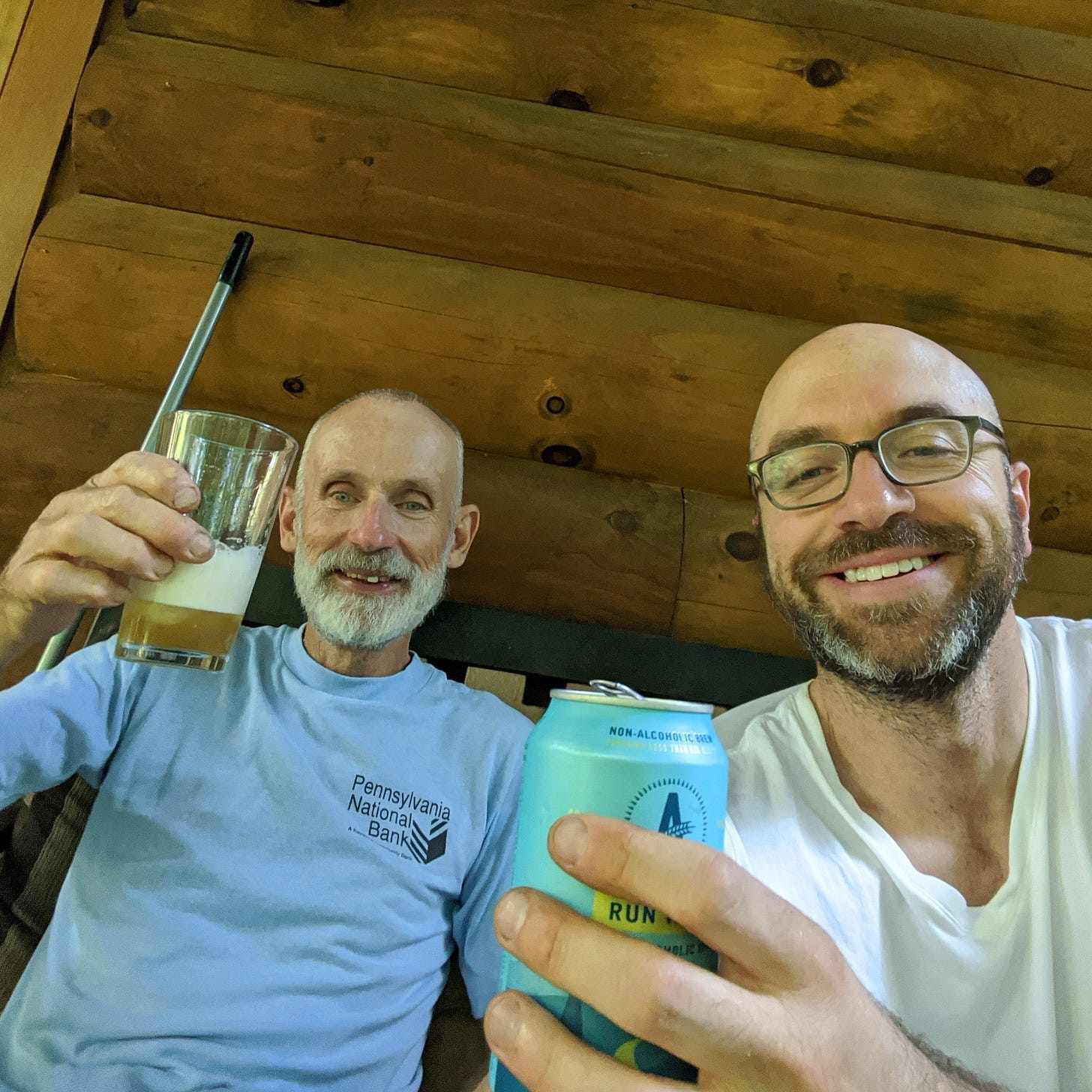
But if I did manage to do reasonably OK during this period (whatever that even means), the thing I credit the most — the thing I’m most thankful for — which might have stood out to you as you’ve read these essays, is this: my most helpful insights and moments came from other people. I am fortunate to be surrounded by a large, diverse, magical group of friends and connections, each of whom has a different perspective that always seems to show up at exactly the right time. I listened to a podcast last summer (possibly Knowledge Project or Tim Ferriss — I haven’t been able to find it again) that suggested that resilience is mostly a group trait, not an individual one. This makes a lot of sense to me, both practically and evolutionarily: humans are stronger together.
But while penguins can huddle together to collectively weather a storm, humans don’t do as well in “support monocultures,” seeking only people like ourselves that provide similar perspectives to what we would offer to others. I’m a brainy logistician, and surrounding myself with other brainy logisticians would’ve been much less helpful (and exhausting). Effective support is a pizza with different toppings on each slice, and I think we need them all. We need the listeners, the brainstormers, the huggers. We need the storytellers, the crafters of memorable one-liners, the experienced ones that are farther down the path with tips for the route ahead. We need the laughing ones, the crying ones, the overt ones, and the “quiet, unexpected ones” (as S.G. memorably put it).
I’m not suggesting that we give up on our psychological work, nor that we abandon our skill building and the systems that sustain us. They are important, but this year has shown me that they are just not sufficient. What worked for me — what showed up for me — was my cornucopia of all of these beautiful souls, and more of their time and support than I could have ever hoped for.
—
Like my dad, I too have been born into this river that I didn’t choose. I think about the river a lot during strange times: a river that began as a trickle, far up in the mountains of history, birthing the ancestral current that propels me, adding to the momentum of the life I’ve created for myself as I’ve chosen different directions. Sometimes I’m in a canoe, easily floating down a quiet stream, but sometimes I’m overboard in turbulence. Sometimes I have desperate times where I need to anchor for stability, but all that’s nearby is a dead tree to try to lasso as the rapid rages. Sometimes people try to throw me ropes as I drift by; sometimes I’m completely alone, worried about getting caught in the sediment that buried my dad. Sometimes I see a white dog, barking on the shore, encouraging me to endure to a better place he found up ahead. Sometimes I follow him, and the river flows into a placid lake, where I stay docked at a cozy cabin for a long while. But the river always comes calling again.
Sometimes we travel in calm, sometimes in a tempest. Sometimes there’s a fork and we can choose our route, other times there is a strong current and we can’t. That’s just what a river journey — what life — is.
I miss my dad. He was one of a kind. And it fills me with sadness that the exact thing that his illness robbed him of was the thing that can help us most in difficult times. He was conditioned to be alone, to not trust others, aspiring to be completely self-reliant to the point of near isolation. Our family is small, and it’s easy to become numb to repetitive voices — so he had no cornucopia to provide him with different tools, perspectives, and the variety of support that a struggling soul could benefit from. He was who he was, caught in a river that was just flowing to the destination it was heading for.
I suppose that in some ways, I am too.
... but friends have boats.
Epilogue
Throughout this series, I’ve looked at grief through all of the lenses, filters and models I’ve encountered. How does it feel? What does it do? How does one best move through it? What is it?
I can’t share a conclusion, as I’ve concluded that this experience really has no conclusion. Instead, I’ll offer my best theory: grief is weather. It has infinite combinations and degrees; few can be fully anticipated, and many are sudden. You can run inside and shelter from some, but others will blow your house down. And even the absence of weather is weather. Weather will always be there, but, it does get a little easier to cope with over time. And it will still surprise you, despite any forecast: just this morning I was reminded how frequently I need advice and reassurance from people close to me about things I’ve explored here in depth. Just because you understand something and can explain it doesn’t mean you are permanently living some evolved, glorious embodiment of it. Even in your 1000th rainstorm, you sometimes still forget to close that damn upstairs window.
A friend (C.A.) who lost her mother in recent years told me that “losing a parent changes your soul.” I asked her if it changes for better or for worse? She said “neither, just different.”
Is this bend in the river taking me somewhere better or worse? I don’t know. Probably neither. Just different.
I’m reminded of something that one of my favorite tech executives once said, (paraphrasing) “The role of the leader is to have a broader perspective, to see when change needs to be made, and to initiate the change. But the actual magic comes from the rebuilding that the organization does as a result.” Perhaps loss can lead us in that same way — that there is magic in the rebuilding of our life.
There is a “shameful” part of the grief process that is hard for people to talk about: the sense of relief that can come from the release of the difficult parts of a life, and the certainty you gain when you no longer have to wonder how and when that life will end. It feels shameful because it veers too close to being “glad” about the loss, which you obviously aren’t. But I think this can keep people away from truly seeking — seeing — the glimmers of hope and joy that are ahead during the darkest times.
Paul Coelho’s quote is apt: “If you’re brave enough to say goodbye, life will reward you with a new hello.” Maybe the trick isn’t to look for what went wrong, or how best to heal, or to be upset that something bad happened, but instead, to find the small voice that’s trying to say hello.
And to be brave enough to say hello back.
—
Thank you for coming on this journey with me. These essays were written over a nine month period, from August 2024 to April 2025.
While I know my writing sometimes flows with a firm conviction, or can appear to have a tidy narrative arc, I don’t want to leave you with the impression that this season of my life is coming to a close with some nice wrapping paper and a bow on a box of learned lessons. Everything is still a huge mess sometimes. (Often.) As I was about to click Post this morning, I second guessed myself for a moment, thinking, “Is it dishonest to end this series while I am still struggling, and while there are still many things to be learned and shared?” But this is a sojourn after all. A journey within a journey. A temporary stay. I will carry the experiences and lessons of this last year with me forever, but I’m ready to start rowing in a different direction.
Spending hundreds of hours this past year writing — and being more enmeshed in literary and philosophical worlds than I ever have before — convinced me that it’s a place I want to spend more time. There is more to take in, more to mull over, and more to create. I’m going to revisit the series on career transitions that I was working on before this sojourn began, which will be a bit of a jump back in time, but I can already see the river of this series beginning to converge with that one. Where I left off, coincidentally, was on the topic of “how to rebuild a life,” so I’m guessing the hellos I’m seeking here are the same ones that will find me there.
I can sense some other, unexpected twinkles of flame beginning to emerge from deep in my soul, too. I mistakenly thought a grief sojourn would be a detour that eventually leads back to the original route, but it changes you too much for that. It challenges your priorities and clarifies your values, and it can’t help but inform what will inspire you, and the choices you’ll make next. I’m not sure what these little fires will become, but I look forward to the journey.
Thank you to my cornucopia of friends from all around the world, who showed up for me, and showed up for my mom, with the dozens of hours of voice notes and cards and visits and emails and flowers. The greatest compliment I’ve ever received was that I “show up,” and, well, all of you certainly did. With your boats and everything else.
I hope I honored my dad’s life and his memory, as well as the complexity inherent to this sort of ending. I wonder what he would think if he read this, from the perspective of the great beyond? I guess I’ll have to ask the next squirrel I see at the window.
David Whyte, in his deeply moving Farewell Letter, wondered what his mother would’ve said to him after she passed, and so he wrote himself the letter he imagined she would have sent. It ends with, “All of your intuitions were true.”
I think I’ll go with that.
I eventually came upon a town at the end of the valley. I decided to remain there for some time; I’ve lost track of how long it’s been. I enjoy the sights and sounds here, the little shops, and the friends I’ve made. I am older now, and I think back to my mountaineering days, my hiking days, the days at the high altitudes, and the nights by the river, with fondness. How angry I was, how worried I was, how lost I was, how found I was.
The earthquake redirected my life. But it gave me at least as much as it took away.
My soul has found renewal here, but I think it’s time to move on. The path continues ahead, and they say if you go far enough, you’ll find a place where the river meets the sea. I may head in that direction. But someone mentioned that there’s another peak off to the west that I might want to climb. I remember I once had such a love for climbing… but the ocean is intriguing, too. Or maybe I’ll just walk for a while.
I made my choice, and set off.
With immense gratitude,
–DH 4/21/25