
Righteous, Muddy Impact
After Work, Part 13

As I write this in early 2026, it occurs to me that 2025 was my only year as an adult without a job, a nomadic bugout, or a family crisis. That allowed for much of my time to be spent quietly — writing, reading fiction, working out, seeing friends, supporting loved ones through difficulties, poking around at city life, and silly motorcycle projects in my basement. I was a simpler version of me, exploring some outer worlds, but mostly my inner world.
Quiet Life has provided a lot of reflection time, and as I’ve done for the last few years, I filled out my YearCompass, as I believe a regular, comparable, formal look-back can be eye-opening. I’ve never been much for resolutions (they tend to “force” things, which doesn’t work for me), preferring the idea of little tweaks and nudges to life instead. YearCompass is great for that, as is Julia Rothman’s More/Less exercise (which is much shorter).
As I considered the changes I hoped to make for the coming year, themes of efficacy & impact kept coming up: I have a growing sense that I’d like to have “more” impact, though it’s hard to say what that means (what’s “more,” anyway?). Plus, considering I’m rarely bored, there isn’t any “blank” time to shift toward new tasks; any changes would require reconfiguration — which invites questions about efficiency, too — how am I spending my time versus what I’m getting out of it?
A quick scan of my days notes a few disparities: certain activities that take up quite a bit of time & energy seem to have questionable value, while some smaller habits net a great deal more: A few hours a week at the gym seems like good ROI; the many afternoons working on bikes only to sell them a few months later … perhaps less so. One of my largest time investments last year was in the themes of Mastery and Service (see Part 6), mainly researching, writing, and editing this Substack. I probably spent close to 1000 hours between this series and A Sojourn into Grief, so how do I feel about the yield? Did I achieve what I wanted or expected to out of these efforts, in terms of skills improvement, personal satisfaction, or mastery of craft? Was what I produced of service in the way I’d hoped? Did it meet my potential? (How does one even measure such things?)
Well, if we accept our earlier conclusion that Mastery and Service are inherently valuable, or that an ideal state is the Big Little Life (see Part 8), then we probably should not be asking such questions. If I enjoyed exploring life through writing, does the specific amount of personal/skills growth matter? If I am being helpful even in the slightest of ways, does the audience size matter? If my time wasn’t optimized but felt like hygge, was one thing truly a “worse” use of time than another?
It’s easy to get lost in this stuff. My guess is that we all have an evolutionary bias toward conservation of energy, giving us an almost automatic instinct for “weighing” stuff — an eye for efficiency, if you will. If we hear that someone has just spent a decade of life and all of their savings on a boondoggle that accomplished nothing, we don’t need to think too hard to decide that’s “worse” than spending much less money and time on some hugely beneficial alternative. (Of course, we’re often wrong — it might not actually be “worse” at all, depending on how we’re measuring — but that takes much more nuanced/analytical thought.)
Infected by Scale
Some of us have spent a big chunk of our lives developing, refining, and being rewarded for our measurement instinct; business brain devotees (like me) that have worshipped at the altar of “Measure → Alter → Measure Again → Repeat” for decades seem to have a more difficult time living in the flow of the indeterminate than the more creative types do. I used to love loading giant piles of complicated data into my head, closing my eyes, and letting my brain engine do its thing and spit out the most optimal course of action. That hasn’t gone away in this era of life; determining impact & making certain I’m using my energy/time/resources as efficiently as possible for maximum effect is one of the most well-used tools in my toolbox. This is also why Effective Altruism resonates so much with business-grounded philanthropists: if the Measure → Alter → Measure approach works for corporate progress, why not for other things? If an organization can’t easily quantify its efforts and results, isn’t that problematic? Turns out it’s not that simple.

Think about the arts, political movements working to shift policy, or nonprofits operating over very long results horizons. How do we measure poetry, by the number of stanzas?! What about the animal rights organization that doesn’t do anything “countable” but succeeds in their ten-year effort to change federal cruelty laws? What about the butterfly effect of a teacher or coach providing a supportive, memorable axiom at a formative time to someone who then goes on to change the world? Are such unmeasurable, speculative, or long-term endeavors undeserving? (This is one of the reasons Effective Altruism is controversial.1)
I’m not dismissing progress through measurement; I built a career on improving technical and human systems and I’m proud of that work. It’s also fruitless to critique innate biological instincts for energy conservation. But I’m worried that I, and many of us — especially those in the high-growth industries of recent decades — have been so infected by scale that we’ve forgotten how to evaluate anything without it. It’s become such a default, we struggle to allow something to just be2 without trying to make it bigger or better or more.
I recall a debate my friend E.I. and I had years ago about whether it was righteous for a person who had demonstrated aptitude for global impact (which they disliked) to spend their time on direct field work (which they loved) instead. I said no, that that would be a disservice to the world — if you have the ability to operate at a larger scale, you have an obligation to do so. She said forcing someone to do something they hate (and burning them out!) is far worse than them doing what they love, even if that might have a narrower impact. In retrospect, my position was crazy: was I so dogmatic about scale as the only way that I thought we should force or shame people into maximized service?! Yikes. I’m now solidly on her side.
It’s easy to see how such dogma can spread, of course: when we’ve been promoted for demonstrating operational efficiency, when our products are celebrated for daily active users, when our validation comes from the number of likes on each post, when our uptime measurements need to march forever into additional decimal places, when the news cycles scare us with endless badness metrics … it’s easy to forget that scale isn’t the only way. Hell, in many areas it’s not even a good way! So many things are better left unmeasured, better not scaled, better enjoyed for what they are, better without knowing the outcome beforehand, better flowed through, better lived in.
Healing the Infection … with Mud
Like most things that have a deep personal/societal rut or evolutionary component, it takes intention to behave differently than what we’ve been primed for. Chatting with my friend K.C. about this, he suggested simply noticing when I’ve been stuck mulling over unsolvable/irrelevant parts of something — in this case, noticing with the awareness that overthinking optimization of impact leaves me both frustrated and can lead to freezing. If I can’t draw a conclusion about A vs B, often I’ll just … shelve it and do nothing. Let’s not do nothing!
I’ve appreciated building this Unsolvable Mulling = Inaction couplet in my mind, though overriding my analyze/optimize/measure instinct is still difficult: my mental lawyer likes to argue with itself about whether something is truly unsolvable or merely needs more thinking. (And I’m certainly not advocating that we abandon deep time on difficult problems.)
To help, I came up with this (very poorly drawn) visualization that has been helpful to tease out the difference:
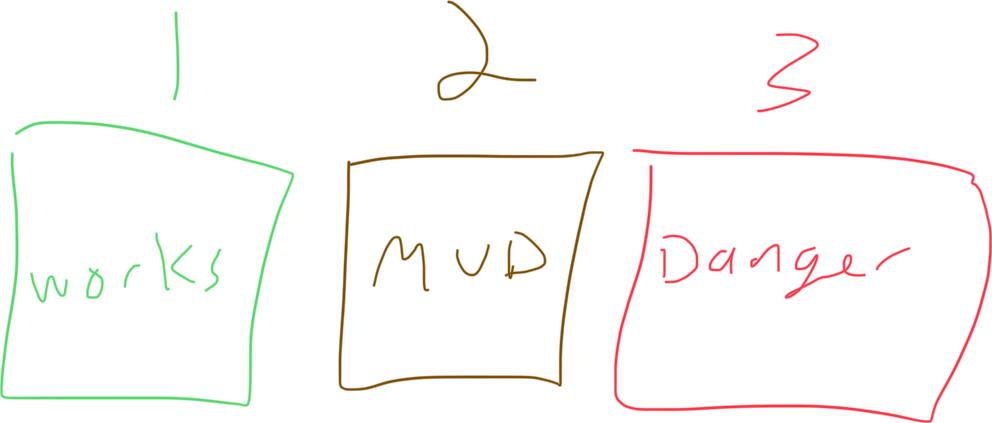
Box One (Green) is stuff that we are fairly certain works, and either is measurably obvious or feels pretty damn obvious.
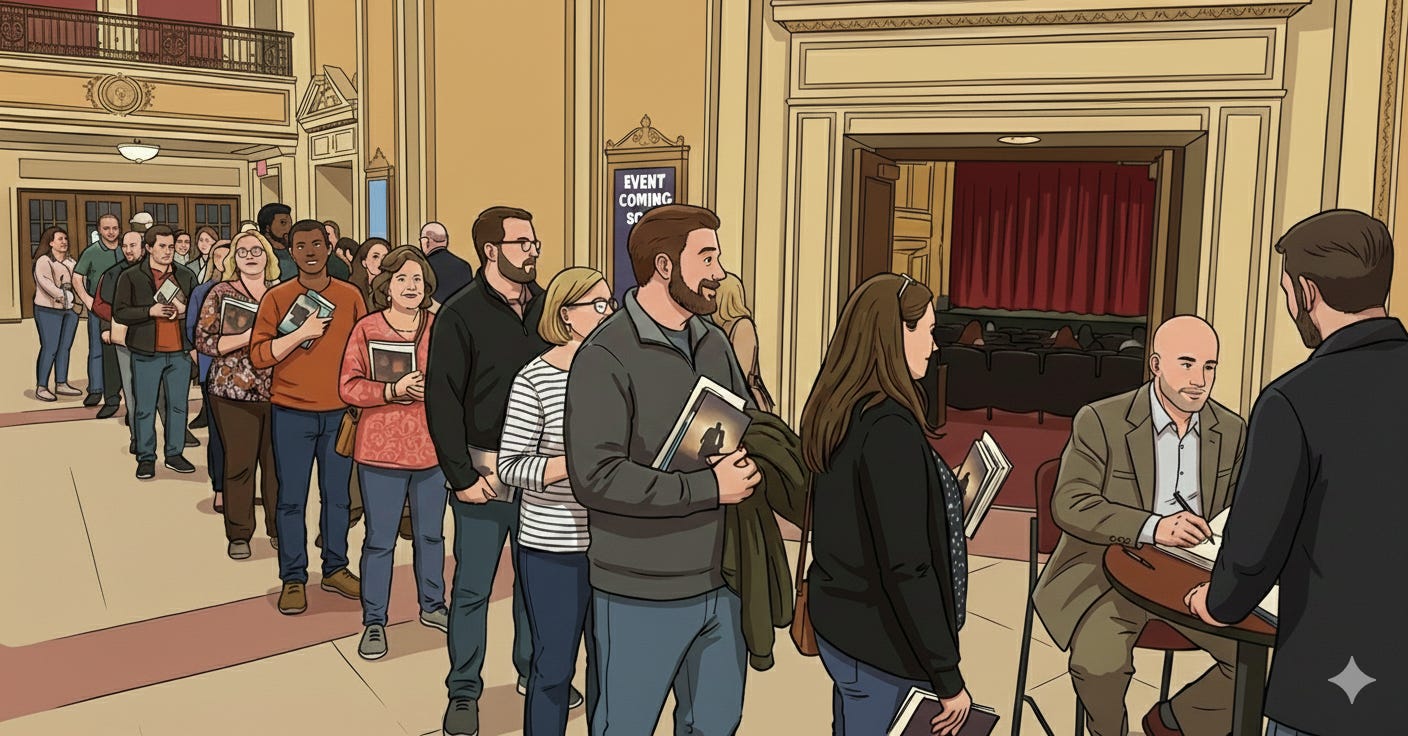
If you give a speech and dozens of people are waiting in line to tell you how it changed their lives, your first thought probably isn’t, “Why isn’t the line longer?” We just let it be.
shit is weird, though I do appreciate the many beards I didn’t ask it for If we’re thinking of donating to something where there is clearly measurable, verifiable impact (say you know you can decrease childhood mortality with a certain amount of vaccination & follow-up per dollar), we send our money and let it be. (If you’re about to argue, keep reading.)
Overthinking these things quickly becomes a silly intellectual exercise, robbing us of time that could be spent actually doing something.
Box Two (Mud) is the box of unknowns. It might work, it might not. Results horizons are so long or indirect that attribution is difficult. Success is not guaranteed. It’s tempting to overanalyze (or over-penalize) here, but sometimes we need to play in the mud. (The world needs people and organizations that do, too!)
Should I take a walk in nature to benefit from the healing of a forest bath, or should I use that time to do a coaching call with an up-and-coming leader? Do either or both; the proportion doesn’t matter because long-term impact is impossible to determine anyway; stop overthinking it!
Should we fund the arts nonprofit without knowing whether the art created will be “good” or “meaningful”? Yes! Unless there are obvious red flags, the arts are righteous, and the butterfly effect makes ultimate value unmeasurable anyway; if something particularly resonates with you, go for it. Don’t overthink it!
I’d like to have a larger impact, but I’m not quite sure how yet. OK! Find a few more readers, why not? Write a book? Sure, give it a try and see what happens. Am I filling stadiums? No, but what I’m doing doesn’t feel like a colossal waste of time, either, so … I’m allowed to believe more people could be helped by my work and try to do “more good,” whatever that might mean. Great! Stop optimizing, go live it all experientially, and don’t get hung up on weird philosophical questions!
I wholeheartedly support playing in this Mud box — with one exception, which I’ll get to below.
Box Three (Red) is the danger zone. This is the place where impact could & should be measured but hasn’t been. Where poor governance practices go unaddressed. Where boondoggles aren’t questioned. Where motivations lean toward shadiness. The things that are squarely in Red tend to be pretty clear (or even extreme).
For example (obviously these are oversimplified, but use your imagination),
If I decide to create a library of videos to help others, but I know for certain that I dislike all social media and have no plans to do any audience development, that’s not likely to be a very efficacious way for me to serve. Seems like the danger zone.
Say there’s an organization claiming to solve a very measurable problem for a dollar amount per unit (“$50 saves one life”), but their overhead is super high, they haven’t invested in tracking and follow-up, and they’ve been at it for a really long time but can’t quantify their results… Seems like the danger zone.
There’s an important nuance here: Red is not where we just automatically stick the Muddy stuff that we couldn’t figure out how to turn Green. “Not Green” ≠ “Red”!
Note that I’m not saying we automatically avoid or cancel everything Red. (That’s why I’ve called it the Danger Zone, not the Don’t Zone.) It’s a danger zone because it’s an indicator of something deeper or problematic that might be going on — often that we’re not aware of — that warrants further investigation.
The Exception: The Why of Impact
There is something that can move an item into the Red box/Danger Zone. It’s often subtle and sometimes devious, hidden in the answer to the question, “Why are you doing this?”
In my own example from above, I stated that I want to have more impact. My uncertainty — the reason I’m not square on whether this desire for “more” is merely Muddy or actually Red — is that I’m not resolved on any deeper truths that might be hiding behind my Why.
Initial answers tend to come quickly and sound plausible (or even unassailable): mine is that I’ve learned a bunch of things in my career/life that seem to be helpful to others, so I’d like to make that knowledge available to more people, in the ways that I enjoy sharing. Sounds reasonable; it’s not very measurable, but it isn’t a clearly red/danger thing either, so we could take my intent at face value, let it be muddy, and move on.
But what if my reason is actually rooted in a savior complex that has been developing since I was a kid?3 What if I was super shy and introverted, but learned that I could obtain the affection I was desperately seeking by performing service tasks? What if the only way I could find self-worth was by building an entire career around doing so? My desire to have more impact, then, wouldn’t be coming from the selflessness I believe it is, but rather to reinforce a fragile ego. We’re at least seeing some hints of Red here, aren’t we?
But what if I’ve never had any therapy and I’m unaware of that deeper reason? That’s not nefarious, so is it so bad? Or what if I am aware, but the net result is still positive? Barack Obama once said something about (I can’t find the quote) how you’ve got to have a particular sort of loose screws to seek the presidency. It wasn’t intended as a funny comment, but that one’s brain/spirit/life needs to be configured in a certain way to remain interested in pursuing such a high level of political achievement over the long timeline required, given the vast downsides of an intense, public existence. While I’d put him high on my list of people appearing to selflessly serve and not “doing it for themselves,” he’s written about his complex upbringing and how it shaped his path. Where do we draw the line between noble pursuit of service and a psychological imperative? Is there even a difference? A quick scan of the childhood bios of many of the people we consider to be exemplars of “pure service” shows many of them embodying Jung’s “Wounded Healer” archetype. This gets very muddy, very quickly…
It’s easy to take this to a malignant extreme, of course: History is full of megalomaniacs that have caused unimaginable suffering; I wonder how many of them believed they were uniquely qualified to do good in the world, possessing what they considered to be a superior intellect, and decided the best way to “amplify their service” was by amassing maximum resources and political power? Where their deep truth was a sad, mistaken belief formed in their tough childhood: that the path to self-worth, love, or safety is through more power, more fame, more fortune … endlessly, never enough.
We’re well into the Red…
The Why of Why
In Part 9 (Deep Work), I wrote about self-knowledge being a key to understanding why we may be more inclined toward — or blocked from — certain courses of action. Here, I’ve been exploring our motivations:
What choices do we think we’re making with agency, but are under the influence of subtle ruts or momentum?
What are we still doing as adults because of a lacking earlier in life?4
What feels real but has elements of self-deception?
But why should we care? After all, most of us will never be in a position to throw a tantrum and mess up the entire planet. Well, consider these three reasons:
One, I think we all have an innate desire to understand how we work and how the world works. When I’m listening to business or political news, I find myself wondering about the subject’s Why: Is that corporate leader leaning more toward an examined life and pursuing mastery, or toward an unexamined one of ego-feeding and misplaced wealth inflation? Is that politician aiming toward a purer form of selfless service, or are they just enjoying the fame and accolades that come from appearing to be service-oriented? (It’s never an either/or, of course — life is one big grey area.)
While humans are diverse and complex, that complexity often manifests in the details, not the basics: deep down, our drivers are all the same simple, rudimentary stuff: safety & security, belonging & love. Looking at ourselves — and at the world — in this way, can be like a cheat code. So my hope is, as we consider our future pursuits, whether personal, career, or otherwise, that we spend the time to learn the deeper Whys that may lie underneath — not to make binary determinations of whether we should or shouldn’t, but so we can walk as informed a path as possible.
Two, if you’re reading this series, chances are you have some interest in what happens when you step away from a Big Thing. Whether that’s due to some form of retirement or just a shift in your passions or priorities, it often means moving away from economic reasons as your primary motivator. This also means losing your financial plausibility sheath: the get-out-of-jail-free card that lets you say, “Well, I have to work somewhere!” Much has been said about the dilemma of what to do with oneself in a post-working era; this talk is one of many. Finding new reasons for doing when you don’t have to anymore is a massive shift out of an old bargain that, if you’re in the West anyway, society signed you up for long before you were born. These questions of What do I do now that I can choose for myself? How do I really want to spend my time? How much do I want to volunteer or give back or serve? What does work mean to me? are ones that we often spend the majority of our lives without an imperative to answer.
The plausibility sheath doesn’t only obscure those questions of self-actualization, but also hard ethical/moral truths: “It’s a bummer that they {have to work so unsustainably hard, have to deal with that awful boss, need to work for that horrible company}, but they have to provide for their family!” Such statements have a way of deferring investigation. Of course I’m not criticizing providing for one’s family; most people have periods of life — often their entire life — working to make ends meet or as a means to an end. But there’s a danger: we can find ourselves doing very questionable jobs (or doing fine jobs in very questionable ways), subjecting ourselves to mentally or physically destructive workplaces, harming our relationships with our loved ones, or providing our labor to industries that are bad for the world, even when we don’t need to anymore, for reasons that we don’t fully understand. Take one look at the FatFIRE subreddit and you’ll see plenty of posts from wealthy people that can’t figure out why they are absolutely petrified of leaving jobs they hate.
Three, how about simply this: the world is messed up enough, so let’s not contribute to it becoming even more messed up, especially not inadvertently. A little honest self-inquiry goes a long way to making sure that we’re on a path we’re OK with.
And as for me — have I sorted out my Why?
I think it’s muddy.
And I think that’s fine.

The head of GiveWell was on the Ezra Klein show recently, and I thought he did an exceedingly poor job of answering the question about how to think about things that have impact but are resistant to measurement.
See my thoughts on Negative Capability from my Grief series
This isn’t exactly me, though it isn’t completely not me, either…
If you’re rolling your eyes at my constant mentions of childhood trauma, please click the link!