
So ... Now What?
After Work, Part 16 & Ellipsis

We’ve gone to many places in this series — in the world, in the mind, and in the heart. This “retirement” era (I still don’t know what to call it) of mine began with the adventurous voice in my soul throwing a tantrum for having been ignored for so long and me finally listening to it; hopefully I’ve given you a sense of what it’s been like to step through to the other side of the door.
Time has passed somehow both quickly and slowly over these four years, and it feels like I’ve done both a whole lot and not very much. Having treated work as the blocker for many of the Life Things I wanted to do, it’s been surprising to discover that when the blockers are removed, I didn’t rush to do many of those things anyway. I had about a hundred big items on my must-do list, and while I’ve done a dozen or so, far more have been removed from the list entirely; I believe we vote with our feet, and we don’t always have to face the fact that something is just a fantasy (not an interest) until we have every opportunity to do it and still choose not to.
Things have gone sideways more often than I predicted, just as many of my strong beliefs proved less durable. There were the big earthquakes like the unexpected death of my dad and some sad events in my personal life, but many subtle things, too: reckoning with purpose, missing certain social, meaning, and leadership aspects of my old life, misplacing the passion I had for Epic Wanderings, struggling with a sense of place, and just dealing with the extreme flexibility, opportunity, and privilege of living the untethered life. It’s been a lot of ups and downs, but I still have zero regrets. (That goal I set years ago of “variety” certainly has been met!)
This series has not only been a chronicle but also my best attempt at wrangling all of these disparate states and times and feelings into something manageable, able to be made sense of for myself, and offered to others in hopes that it might be helpful. And I tried to wrangle it; I really did! This has been the longest and most challenging thing I’ve ever written — it really has been maximum effort1 for me, trying to apply this well-oiled business engine on my shoulders to these hard tasks of living.
Of course, messy periods, grief periods, rebuilding periods, difficult emotions, and the existential questions that we all struggle with really don’t love being ordered. I read On the Calculation of Volume last month, and the author did such a beautiful job of putting words to many common but intangible, complex states that everyone experiences yet resist description; I don’t think I approached her level of prowess in these writings, but I’m proud of the attempt. Truth is, though, despite their high utility in many areas, logical, business, and operational tools can only take us so far.
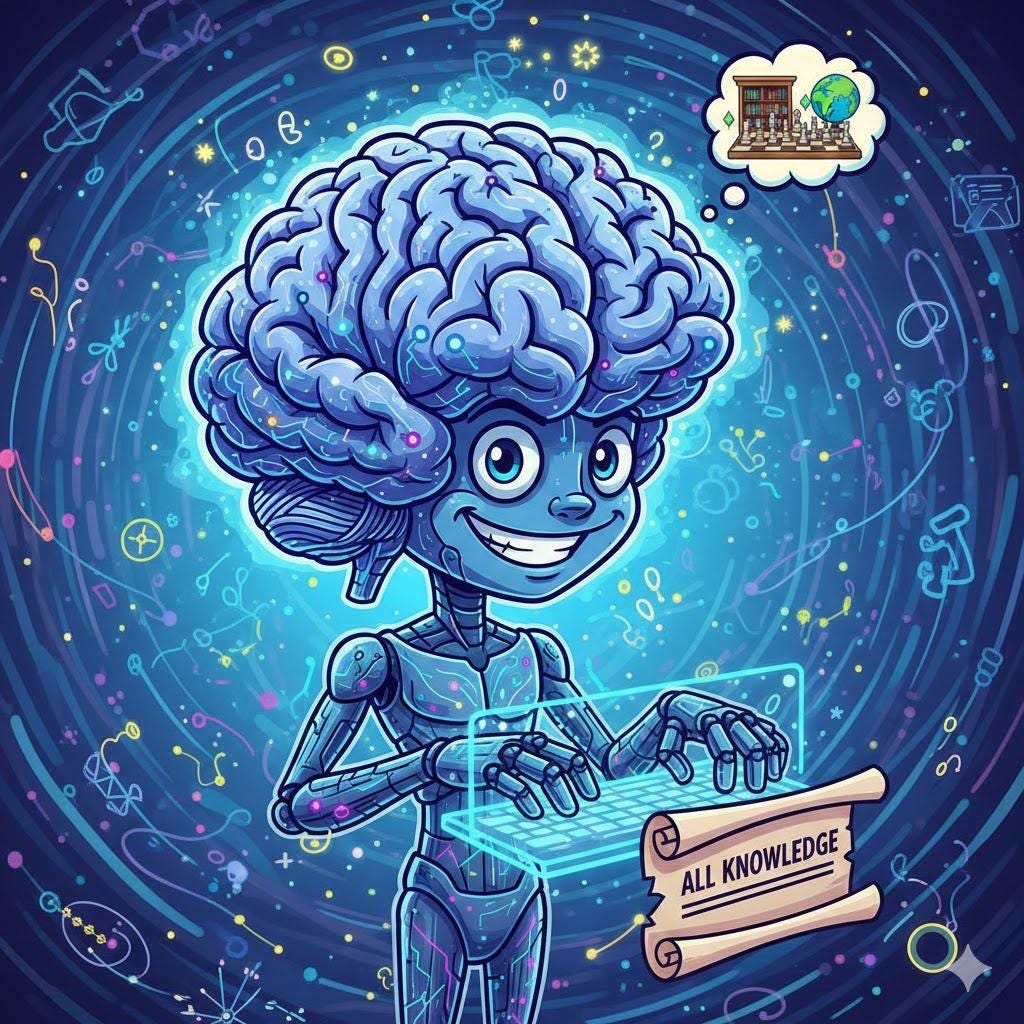
As my therapist said recently, “You can use those tools in support of what you need now, but not as a substitute.” So what does life call for instead? What happens if we dare to let go of measuring, optimizing, maximizing, finding efficiencies? I suppose we’re left with living & experiencing without thinking so much about it or needing to make so much sense of it. Easing more into that gardening life. Getting out there and doing — lots and lots and lots of doing. (Not the easiest prospect for an introvert…) Plant a little here, experiment over there, mend the fence when needed, deal with the flood that occasionally ruins everything, dig your trench to drain it and hopefully divert the next one, and try again next year. Homeostasis is not achievable in an ever-changing world, but nor would we want it to be; much of life ends up being in that mud box … but isn’t that what keeps it interesting?
If we give the softer terms more air time — play, warmth, flow, awe, and inspiration — even the busiest-brained of us might find a little more ease. And a little more is all we’re looking for, anyway. (There’s a reason Dan Harris called it 10% Happier and not 100% Happier!) Sure, sometimes we’ll need to summon the bold action of the hyper-brain, but more often than not, I think a little editing will probably suffice.
Let’s slide over a little from nonfiction to fiction
from doom scrolling to epic novels
from documentaries to movies
from business books to poetry books
from noise-canceling headphones to forest baths
from lonely home offices to coworking spaces
from training to exercising
from online communities to in-person communities
from engineering to art
This isn’t to say that we should disengage from the world, ignore atrocities, or not do our damnedest to bend the arc. But we will not be able to do/be our best if we’re frazzled or miserable. We’re all on a journey that ends — and we don’t know when — so let’s try to enjoy it a little more along the way. (“It’s later than you think,” as the song goes.) Keep smiling and laughing, nudging our little sliders through the gradations toward places of more ease, as the world evolves around us, as we evolve ourselves. Charlie Mackesy says it best: Let’s let it be a little more messy. Let’s have a little more fun with it.
Let the Sparks Be
In Part 12, I mentioned the idea of “stopping” something to allow the next thing to enter, though I’ve also written about how heavy and intense binary stops and starts don’t serve us. While certain things do require declarations (only purgatory benefits when we “sort of” leave a job or a relationship), maybe there’s room for a new tactic: David Whyte in his January Three Sundays spoke about the idea of centering — not only to come from a place of calmness but as a way to reconnect with the you that’s about to step forward.
When I practice centering for some of my conflicted areas, I can feel the tension ease: Adventure-me didn’t die or end; he’s re-centering to allow the “now” version of him to emerge. Maybe he isn’t using expeditions to flee or for maximum bucket list life-seizing anymore, but learning to use them for awe, contemplation, and camaraderie. Leader-me isn’t done or over, either; he’s re-centering to allow the “now” version of leadership to emerge. Maybe he’s not lost in a corporate economic ego loop anymore, but trying to find a new source to make a contribution to the world.
From the centered place, I see a starfield made up of tiny little sparks — personal mini-supernovas that brighten every so often. Little hands waving, little voices whispering, little embers glowing:
P.K. asking me whether I’d ever consider having a “big job” again and a “yes” emerging unexpectedly. // Jacinda Ardern on the stage & thinking that I might enjoy being up there. // Reading about her Field Fellowship and hearing myself say, “Oh, I’d actually love to help with that.” // M.B. telling me I was “better when I was leading.” // The warmth that came when I realized descents are part of a journey, that my career wasn’t a failure after all, and that leaving a job isn’t the career-ender I believed it to be. // Dreams of a cozy study with wildlife outside from which to do scholarly, heart-filled work, then realizing I was already doing it. // Someone jokingly mentioning they were looking for a leader in their startup, and finding myself actually considering it for much longer than I would’ve thought. // Feeling hints of Ikigai around what the world needs right now and how my skills might apply. // Discussing uninspiring political candidates with a friend, him asking “Why not you?” and it taking a longer time than it should have to come up with good reasons to say no…
When I mention my sparks to friends, the response is usually something like, “Well, what are you going to do with those feelings?” To which my answer is, “Right now, nothing,” which tends to be met with a look of disappointment or even horror. Our attitudes around this are peculiar; why is not seizing on an inspirational moment a radical act? Sparks are so fragile and delicate that breezes of over-analysis can extinguish them before they have a chance to mature. While the thought experiment at the end of the last piece (“Imagine if your dream person/company/cause called you to serve”) is intended to conjure infernos, that’s usually not how a spark of hello arrives; they’re often just embers. If you don’t give them some space — without judgment or critique — they won’t grow. The breath of your “nah” can stomp out an ember, but it’s irrelevant to a raging fire of interest.
So, for now, I choose to let my little hellos just be, and to trust that some will grow when the conditions are right.
Ellipsis
In my Grief series, when I had written what I felt needed to be written, I wrote a conclusion and got back to working on After Work. 16 parts and many many months later, while I can’t say I’m ready to write a conclusion here, we’ve caught up to the present-day of my life — so I need more to happen before I can write about it! Instead of a conclusion, let’s call it an ellipsis.2
As I’ve been reflecting on these essays, I noticed a commonality among the authors, poets, politicians, business leaders, and mentors that have affected me the most: they all initially appeared to have the answers that I was desperately seeking, but instead of giving me the how-to, they told a story instead. Like Jacinda Ardern, whose book I expected to be a how-to for compassionate leadership but instead found a compelling autobiography that opened my mind to so much of what I’ve written in the second half of this series. Or like Joan Didion, whose book on grief I first despised because of how meaningless the text felt when I needed concrete specifics, but months later, realizing that what she wrote was actually communion.
I’ve been reading a lot of fiction lately, and my favorite stories are those that have a solid ending but still leave you with the sense that the world you’ve been invited into is continuing — out there, somehow. To learn what became of the characters, you have to take what has been given to you and then fill in the possibilities with your own imagination & your own experiences. The great storytellers aren’t intentionally withholding; they know that for their offering to connect deeply, their story has to be merged with yours.
Absorb what is useful, discard what is not, and add what is uniquely your own.
—Bruce Lee
These last few pieces have been some of the hardest to write & revise since I started publishing, as I’ve tried to make certain that I covered everything I wanted to cover, put a bow on each topic, and provided a tidy sense of completion. This hasn’t been working, of course, because I’ve made the same mistake in writing as I made in seeking: I thought I was writing a how-to, but it turns out I’ve just been writing a story.
I can’t offer the tidy ending — not only because this character is still going to be out there somewhere, doing his thing, but because whatever you choose to do with all of this is up to you. I’ve written my part. Now you have to write yours.
It’s been nearly a year since my first Substack post, made with great trepidation, fearful about making my work visible. 70,000 words later, I’ve really come to enjoy this daily practice of writing, and the Substack Editor has become a comfy place to spend my mornings. When I began, I was hoping to share my answer to the question, “What happens when you blow up your life and leave that huge thing?” I guess all of this is what happens (to me, anyway). I know some of you have been following along as a way to keep up with an eccentric fellow that was a part of your life for a while, others may be seeking camaraderie after having done your own big exit, still others trying to decide whether you might want to do something similar. For all of you, I hope it has been interesting or at least thought-provoking. But specifically for that last group — the wonderers — I wish you peace in your conflicted soul and the curiosity to connect with that part of you that already knows what you need to do.
Once in a while, a path calls to us, as if it’s written in us. These are the things we intuitively know must be honored, for if we do not even attempt them, we risk breaking our own hearts. These are the beckonings of our future self, guiding us forward as we arrive to the place we had long dreamed of, with a sense of revelation.
As for me, I’m going to keep exploring these themes, the inner and outer worlds, the mountains and the valleys. There’s a comfort that has come with midlife; knowing who I am and what lanes I enjoy provides some relief from the terror of endless possibilities — I can’t do everything, nor do I want to! I’ll keep writing for sure; next will be some more work on grief, and later, much more on leadership topics — but I also miss doing collaborative work, so certainly more of that somehow. And as I put on my coat and dare to venture up the hill again, I’d imagine that eventually I’ll run into a leadership role that’s too compelling to say no to, or that my wandering soul will come out of hibernation for more epic adventures. (It would be highly annoying if I never make it to Patagonia, the Himalayas or finish the Trans America Trail!) Of course, I’ll keep on nudging those life things that always seem to find a way to be in some sort of flux — companionship, dogs, family, a sense of home, the right proportion of time in the woods, the city, and the water, and increasing the number of days per year spent in German beer gardens with my soul friends. Who knows what else? Life has a way of putting very unexpected things right in the middle of our path.
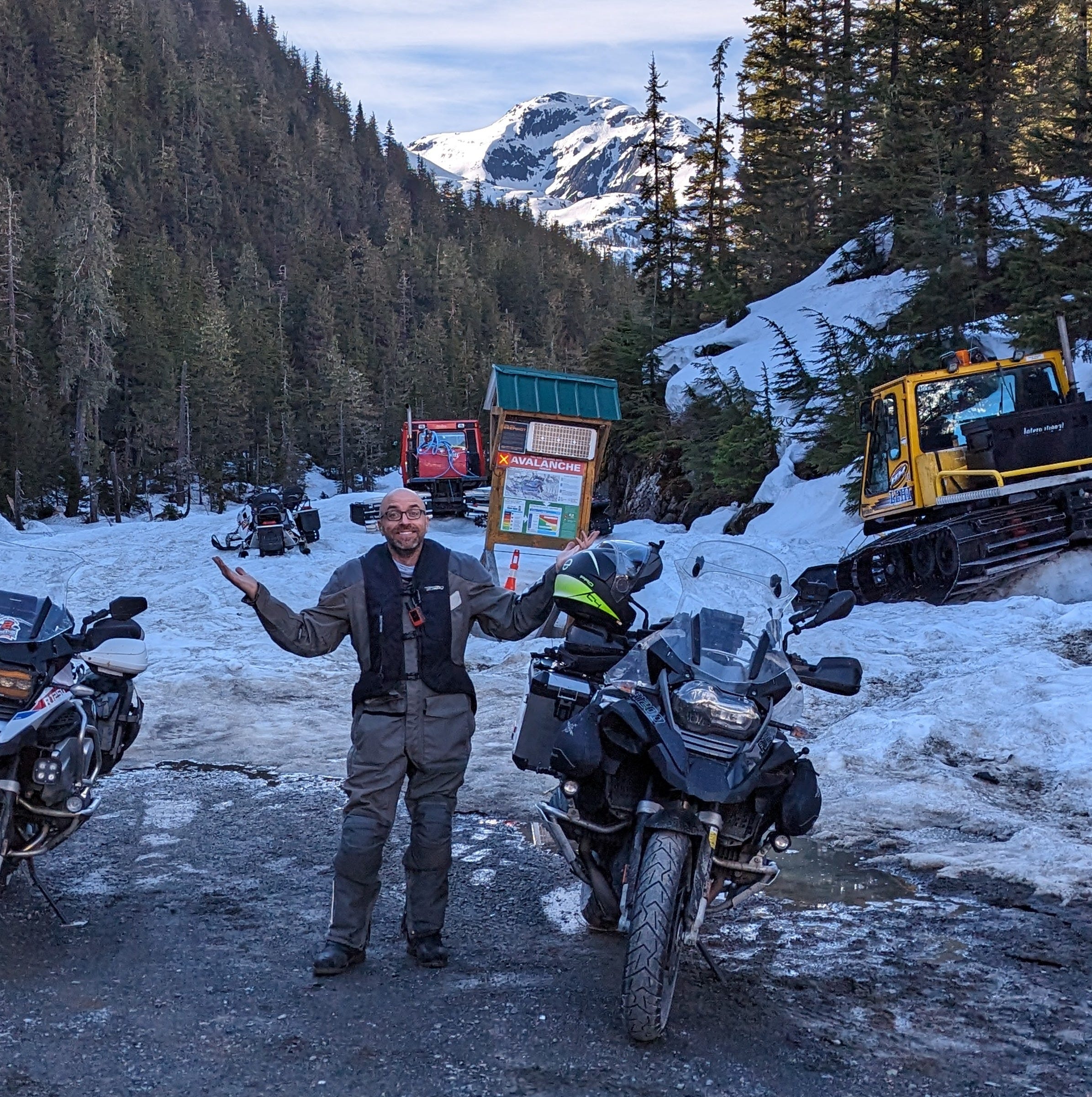
So with a blessing for new beginnings, I’m going to end this series — but I’m sure I’ll come back to After Work from time to time, as experiences, life lessons, and metaphors lend me their invitations…
Thank you for reading, especially if you’ve made it through all sixteen parts. And thanks to everyone who gave me ideas, supported this work, and encouraged me along the way: KC, AKC, KK, BF, ST, AS, VS, MB, CV, RG, PR, PK, EI, GC, NF, CQ, LF, ML, KM, AF, SH, JR, JL, MM. You are my people.
That’s all for now. I’ll see you … out there.
Deadpool!
Thank you for sharing your gift of writing with us. So many gems of insight and inspiration woven throughout, as you vulnerably and courageously share your unfolding. Honored to be included. ♥️♥️